Researchers of the Institute for Cognitive Neurosciences Presented Research Results at a Conference in Japan
The Sixth International Brain Stimulation Conference is not only a major scientific event but also a highly productive interdisciplinary meeting that provides excellent opportunities to discuss the latest advances in the field of brain stimulation.

Leading researchers in fundamental science, such as cognitive neurobiologists, engineers, psychiatrists, neurosurgeons, and other specialists, convene every two years to attend presentations by their peers, promote dialogue at the intersection of different fields, and view the latest achievements in technological progress at one of the largest equipment exhibitions in the world.
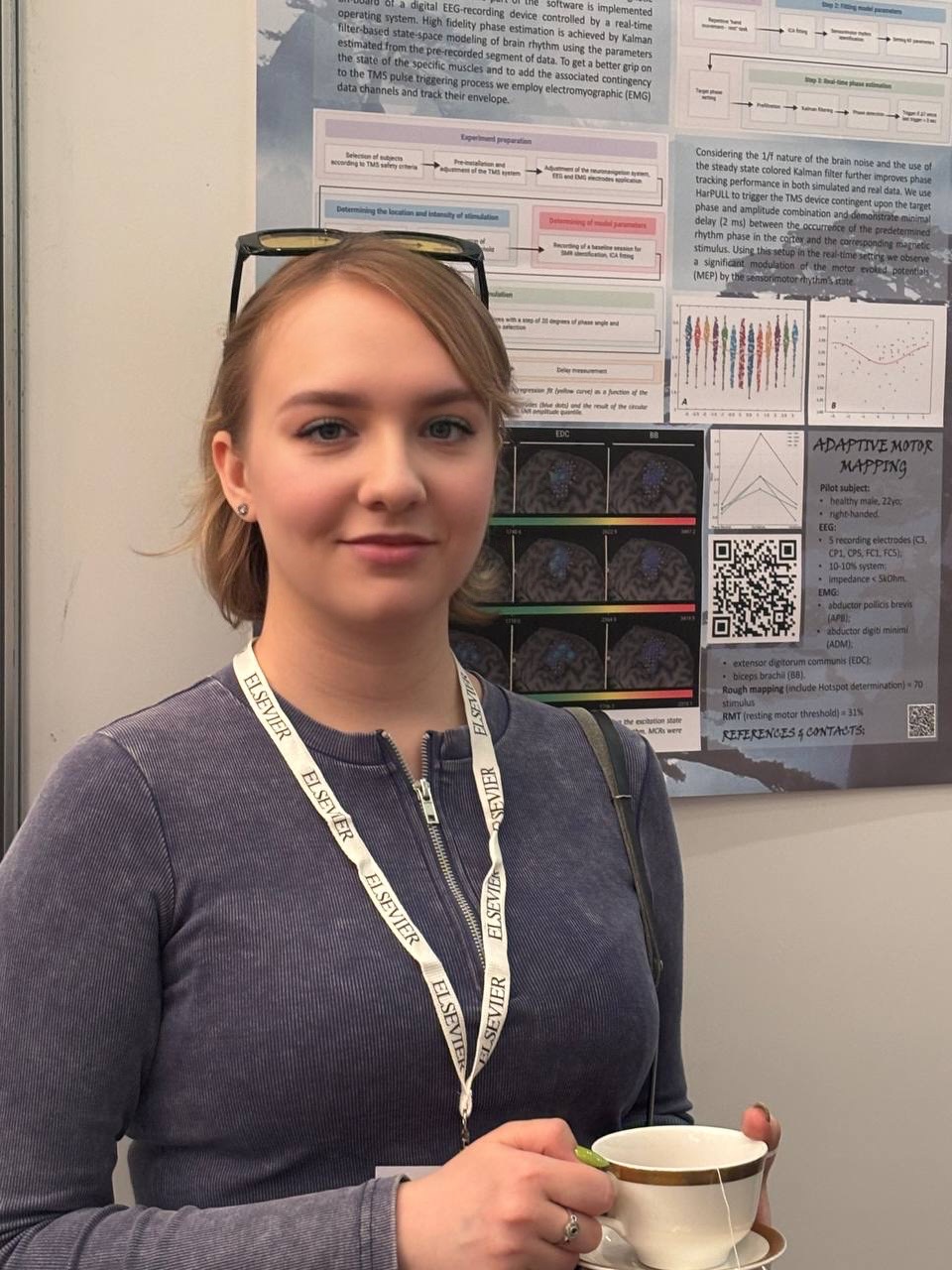
Milana Makarova, a research intern at the Institute of Cognitive Neurosciences, delivered a joint presentation on behalf of the Neuronal Process Dynamics Group at the Center for Bioelectrical Interfaces. The talk was titled “Hardware-powered ultra-low latency (HarPULL) brain-body state-dependent TMS technology for investigation of the motor system.”
“We expect that our findings, along with the newly developed algorithm and mapping methodology, may eventually find application in clinical rehabilitation for patients with lesions in functional brain areas. I was fortunate to receive insightful comments from senior colleagues from abroad during the presentation, and we will certainly incorporate their suggestions into our upcoming research,” Milana added
The talk presented the outcomes of a study that developed a Kalman filter-based algorithm integrated into the onboard system of an EEG amplifier. This allows for adaptive brain stimulation with minimal time delay. The researchers also shared the world’s first adaptive maps of the motor area in a healthy subject, which were obtained during the study.
The study was carried out under the “Centers of Excellence” project run by the National Research University Higher School of Economics (HSE University).